
The Hidden Friction in International Growth
Suppose you finally land a large wholesale order from a customer in France. You pack the box, print your standard Shopify receipt, and ship it off. A week later, you get a notification: your package is sitting in a customs warehouse, and the authorities are demanding a $5,000 “improper documentation” fee.
This is the “Border Wall” that many new and even established brands hit. A commercial invoice is not just a receipt; it is a legal declaration used by customs to determine taxes and safety. If your document is missing the right codes or formatting, your goods simply stop moving.
This guide explains how to set up your Shopify store to handle the newest 2026 global shipping requirements so your packages clear customs without human intervention.

Why Your Basic Shopify Invoice Isn’t Enough in 2026
You may ask why the simple PDF you send to local customers won’t work for international shipping. The reason is that customs officers do not care about your branding; they care about data.
As of 2026, the European Union has moved forward with the VAT in the Digital Age (ViDA) initiative, which requires invoices to be machine-readable (https://taxation-customs.ec.europa.eu/taxation-1/vat-digital-age_en). A standard image or basic PDF often lacks the structured data fields that automated customs scanners now require to calculate duties instantly.
A commercial invoice must include specific details that a standard receipt ignores:
- Full legal name and Tax ID (EORI or VAT) of the sender.
- The exact 10-digit HTS code for every item.
- The “Incoterms,” which define who is responsible for shipping costs and insurance.
The Root Cause of Customs Delays
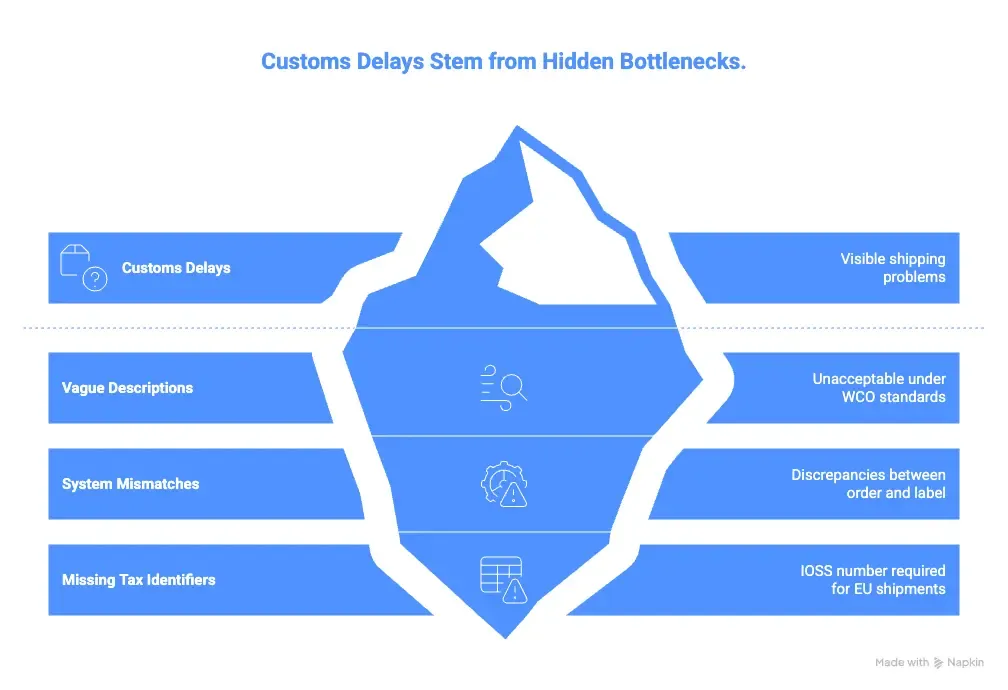
Most shipping problems start before the box is even taped shut. When customs agents flag a package, it is usually because of one of these three bottlenecks:
- Vague Descriptions: Using terms like “Clothing” or “Gift” is no longer acceptable under 2026 World Customs Organization (WCO) standards. Customs systems now require precise descriptions to prevent the shipment of hazardous materials (https://www.wcoomd.org/en/topics/nomenclature/instrument-and-tools.aspx).
- System Mismatches: Your Shopify order might say the package weighs 2kg, but your shipping label says 2.1kg. This 100g difference can trigger a physical inspection because it looks like you are hiding undeclared goods.
- Missing Tax Identifiers: For EU shipments, failing to include an IOSS (Import One-Stop Shop) number on the invoice means your customer will be charged VAT twice—once at checkout and again at their front door.
The 2026 Commercial Invoice Workflow
To stay compliant, follow this step-by-step process for every international order.
1. Identify Your 10-Digit HTS Codes
While standard HS codes are 6 digits, many countries now require the full 10-digit Harmonized Tariff Schedule (HTS) code for precise duty calculation. You can find these using the official US International Trade Commission tool (https://hts.usitc.gov/).
2. Validate Customer Tax IDs
If you are selling B2B (Business to Business), you must include the buyer’s VAT or GST number. Use a validation service to ensure the number is active before you ship, as an invalid ID will cause the package to be rejected at the border.
3. Generate Machine-Readable Documents
Instead of a manual Word document, use an app that generates invoices in the UBL (Universal Business Language) format. This allows customs software to “read” your invoice without a human having to type in the data.
4. Match the Packing List Exactly
Ensure the total value, currency, and weight on your commercial invoice match your shipping label and packing list perfectly. Any discrepancy is a red flag for automated risk-scoring systems used by customs.
Tools to Automate Your Compliance
You do not have to do this manually for every order. Several Shopify apps are designed to handle these legal requirements for you.
Sufio is a strong choice for brands that need to comply with the EU’s ViDA requirements. It automatically captures VAT numbers at checkout and generates invoices that meet international tax laws.
Invoice Falcon offers a more visual approach. It is great for brands that want to maintain a high-end look while still including the necessary legal fields like HS codes and country of origin.
These tools help by pulling the data directly from your Shopify admin. This reduces the risk of typos that often lead to shipping delays.
If your basic PDF invoice workflow isn’t automated yet, that’s worth setting up first — it makes the jump to commercial invoice compliance significantly smoother. Here’s how to create and automate PDF invoices in Shopify →
Actionable Tips for 100% Clearance Rates
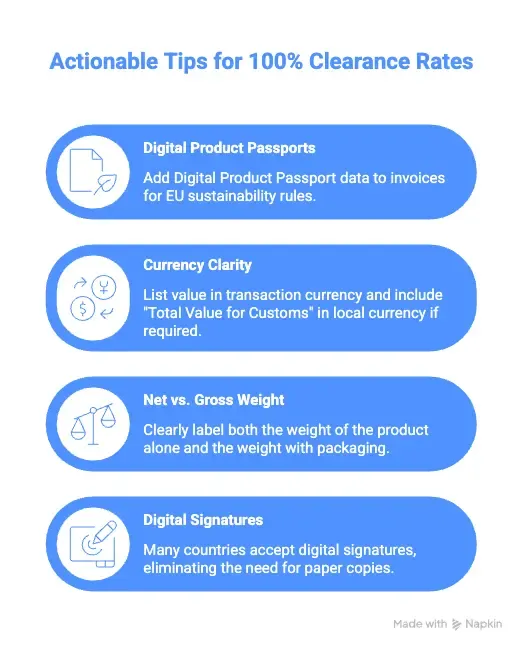
- Use Digital Product Passports: If you sell in the EU, look into adding Digital Product Passport data to your invoices to meet 2026 sustainability transparency rules (https://commission.europa.eu/energy-climate-change-environment/standards/eu-ecodesign-regulation_en).
- Currency Clarity: Always list the value in the currency used for the transaction, but include the “Total Value for Customs” in the local currency of the destination country if required.
- Net vs. Gross Weight: Clearly label both the weight of the product alone (net) and the weight of the product with all packaging (gross).
- Digital Signatures: Many countries now accept and prefer digital signatures on invoices. This prevents the need for “original” paper copies to be attached to the outside of the box.
Frequently Asked Questions
What is the difference between an HS code and an HTS code?
An HS code is a 6-digit international standard used by almost all countries to categorize products. An HTS code is usually 10 digits and is specific to the country you are importing into for determining exact tax rates (https://www.census.gov/foreign-trade/reference/codes/index.html).
Do I need a commercial invoice for every country?
Yes, any shipment that crosses an international border (outside of specific trade zones like the EU) generally requires a commercial invoice. Even “samples” or “gifts” need a declared value and a commercial invoice to pass through customs safely.
How do I handle shipping “Gifts” on Shopify?
There is no “Gift” loophole for businesses. Even if a customer marks an order as a gift, you must provide a commercial invoice with the actual market value of the items to avoid being flagged for tax evasion.
What happens if I put the wrong value on the invoice?
Under-declaring the value of goods to help a customer avoid taxes is considered fraud. According to the U.S. Customs and Border Protection, this can result in the seizure of goods and significant civil or criminal penalties (https://www.cbp.gov/trade/programs-administration/penalties).
Does Shopify generate these invoices automatically?
Shopify provides basic order summaries, but for true international compliance (including HTS codes and VAT/IOSS numbers), most merchants use specialized apps like Sufio or Falcon. This ensures the data is formatted correctly for 2026 customs standards.